
What To Know
- Passionflower (Passiflora incarnata) is a calming nervous-system herb traditionally used for a racing mind, nervous tension, restlessness and difficulty sleeping.
- Clinical studies have reported reductions in anxiety and perceived stress, along with improvements in sleep quality and total sleep time.
- Its personality is gentle but purposeful: it may help someone feel more settled without necessarily producing heavy sedation.
- Tea, liquid extracts, tablets and capsules can differ considerably in strength and preparation, so they are not dose-for-dose equivalents.
- Passionflower may add to the effects of sedating medicines or supplements and should be avoided during pregnancy.
What Is Passionflower?
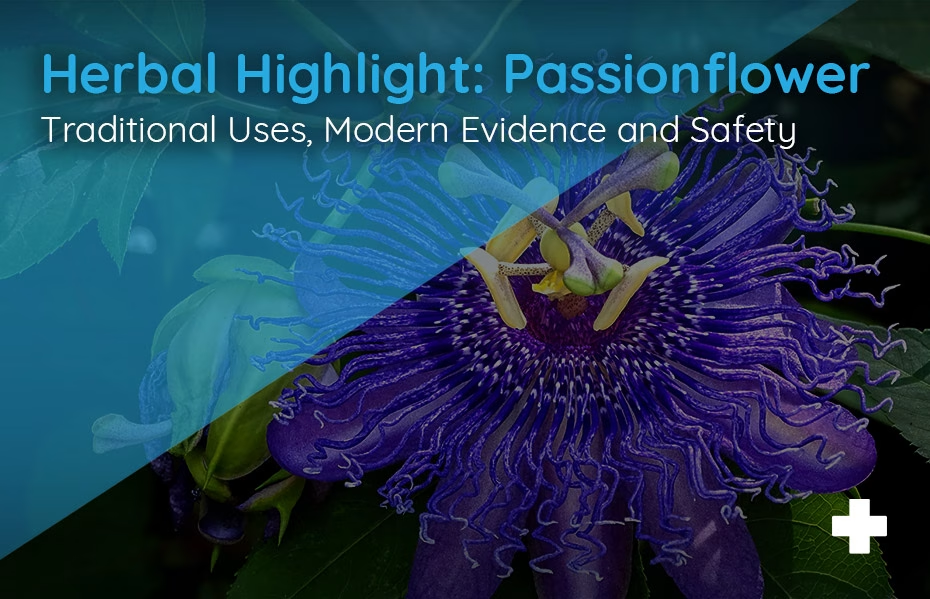
Passionflower is a fast-growing perennial vine with large, intricate white and violet flowers. The medicinal species is Passiflora incarnata, a plant native to the south-eastern United States and now cultivated in many parts of the world, including Australia. It is different from Passiflora edulis, the species most commonly grown for the passionfruit we eat.
Herbal preparations use the aerial parts of the plant: the leaves, stems and flowers above the ground. The name itself has a rather dramatic history. Spanish missionaries saw symbols of the Passion of Christ in the flower’s unusual structure, which is how the plant became known as Passionflower.
Its use as a medicine goes back much further. Indigenous peoples of the Americas used Passionflower as a calming and sleep-supporting plant. It was later taken into European herbal medicine, where it became an established remedy for nervousness, restlessness, mild mental stress and insomnia (Miroddi et al., 2013).
The Personality of Passionflower
Herbalists often understand a plant not only by a list of conditions, but by the pattern of the person in front of them. Passionflower fits the person who is tired but still mentally alert, whose thoughts continue long after the day has finished, or who feels as though their nervous system is always hovering in the “on” position.
I always like to say that Passionflower is the perfect herb for someone that struggles with a racing mind, or finds it difficult to switch off. It’s gentle and significantly therapeutic at the same time.
Passionflower doesn’t knock out us, but helps quiet the mental noise and ease the nervous tension that is preventing our rest in the first place.
That distinction is important. Passionflower is not necessarily about knocking someone out. Its value is in helping quieten the mental noise and ease the nervous tension that may be preventing rest in the first place.
Inside Passionflower
Passionflower contains a complex mixture of plant compounds, particularly flavonoids such as vitexin, isovitexin, orientin and apigenin. As with many herbs, its effects are unlikely to come from one compound acting alone.
Laboratory research suggests that certain Passionflower extracts may influence gamma-aminobutyric acid, better known as GABA. GABA is one of the brain’s main inhibitory chemical messengers. In simple terms, it helps reduce excessive nervous-system activity and supports the shift from alertness towards calm.
This provides a possible explanation for Passionflower’s traditional use when worry, physical restlessness and poor sleep occur together. The exact activity depends on the species, plant material and extraction method, which is one reason different Passionflower products can feel quite different in practice!
Indicated Uses of Passionflower
Passionflower is most useful when nervous tension, mental overactivity and poor sleep are part of the same picture. The European Medicines Agency recognises its traditional use for mild mental stress and to aid sleep, and clinical research helps show what those benefits may look like in everyday life.
Racing thoughts and difficulty switching off
This is the classic Passionflower picture
The body may be tired, but the mind is still reviewing conversations, planning tomorrow or moving rapidly from one thought to the next. You mind literally struggles to shut off, it’s still stuck in the office at work.
Passionflower may help soften that feeling of mental overactivity so the nervous system can begin to settle. It can be particularly relevant in the evening, although practitioners may also use it during the day when constant thinking and internal tension are making it difficult to relax or focus.
Mild anxiety and nervous tension
Passionflower may help reduce the sense of worry, apprehension and nervous tension that accompanies mild anxiety. A 2020 systematic review examined nine clinical trials, with most reporting lower anxiety levels after Passionflower was used.
One small four-week trial compared Passionflower extract with oxazepam in 36 adults with generalised anxiety disorder. Both groups experienced improved anxiety symptoms by the end of the study. Oxazepam acted more quickly, while the Passionflower group reported fewer problems with impaired work performance (Akhondzadeh et al., 2001).
For more on why anxiety can affect both the mind and body, see Anxiety Explained: What Happens in the Body and What Can Influence It.
Stress, restlessness and feeling constantly “on”
Stress is not always experienced as a clear anxious thought. Sometimes it appears as an inability to sit still, a sense of internal agitation, physical tension or the feeling that the day’s momentum never quite stops.
In a 2024 randomised placebo-controlled trial involving 65 adults with stress and insomnia, a standardised Passionflower extract reduced perceived stress, improved general psychological wellbeing and increased total sleep time over 30 days (Harit et al., 2024).
This means passionflower is very applicable when it comes to daytime stress carrying over into our evening routine. It can help us manage that stress better, and improve our bedtime sleep recovery!
Difficulty falling asleep and shortened sleep
Passionflower is commonly used when poor sleep begins with an active mind. It helps address our nervous tension and mental activity that may be keeping us awake.
In a double-blind placebo-controlled study of 41 healthy adults, one week of Passionflower tea improved participants’ ratings of sleep quality (Ngan & Conduit, 2011). Another randomised trial involving 110 adults with insomnia found that two weeks of Passionflower extract increased objectively measured total sleep time by approximately 23 minutes compared with almost no change in the placebo group (Lee et al., 2020).
The 2024 stress and insomnia trial also found an increase in total sleep time, reinforcing Passionflower’s fit for people whose sleep is being disrupted by stress and difficulty winding down.
Sleep is a tricky one though, and Passionflower is not the all-in-one fix for our sleep. We also must consider light exposure, routine, caffeine, alcohol, pain and underlying health issues too. Read more in Sleep Hygiene.
Short-term situational anxiety
Passionflower is also really good for that short-term situational anxiety. I remember many times where I knocked back some Passionflower before a big exam. just to dial down the noise.
In a study of 60 outpatient surgery patients, a single dose taken before the procedure lowered anxiety without increasing sedation or impairing psychomotor recovery (Movafegh et al., 2008).
A second randomised study involving 60 people undergoing spinal anaesthesia found that Passionflower prevented the usual rise in anxiety without changing psychomotor function, sedation or cardiovascular measurements (Aslanargun et al., 2012).
The takeaway here is that Passionflower promotes calm in the moment without leaving a person groggy or heavily sedated.
Forms and Dosing
Passionflower is available as herbal tea, dried herb, liquid extract, tablets and capsules. Tea can be a gentle way to include it in an evening routine, while liquid extracts and standardised tablets or capsules may provide a more concentrated preparation.
The form matters because the amount of herb, extraction method and concentration can vary widely. A dose used in a study cannot automatically be converted into an equivalent number of cups of tea, millilitres of liquid or capsules.
I won’t delve much into the specifics of dosing, because if you’re looking at liquid extracts or standardised tablets, it is very important to discuss this with a Herbalist or Naturopath.
Passionflower Safety and Interactions
Passionflower is generally considered reasonably well tolerated for short-term oral use, but possible side effects include drowsiness, dizziness and confusion.
I know we said Passionflower isn’t exactly sedating, but it does technically carry sedative properties. Use extra caution with medicines or supplements that cause sedation, including sleep medicines, benzodiazepines and some antihistamines. I would also avoid driving until you know how Passionflower effects you.
When using Passionflower during pregnancy, like with most supplements or herbal medicines, it should not be self-prescribed without seeking professional advice first. Passionflower is generally considered quite safe, but guidance is always recommended. Some herbs definitely should not be used in pregnancy or lactation, so caution is always key.
The Bottom Line
What I like most about Passionflower is that it has a very recognisable place. It suits the person who feels tired but wired, whose mind keeps racing and whose nervous system needs some help finding its way back towards calm.
Its long traditional use is now supported by studies reporting reduced anxiety and perceived stress, better subjective sleep quality and increased total sleep time. It is a good example of a herb that can be gentle without being insignificant.
The species, dose and the individuals situation does matter, and it’s a relatively low risk herb when considering other factors, but professional guidance is always recommended.
Please note: Persistent or worsening anxiety or insomnia still deserves proper assessment. If you have been battling with a chronic condition for some time, reach out to a health professional to see where they can help.
Frequently Asked Questions
What is passionflower traditionally used for?
Passiflora incarnata has traditionally been used for mild mental stress, nervous tension, restlessness and difficulty sleeping.
Does passionflower help anxiety?
Clinical trials have found that passionflower extract can reduce anxiety symptoms, including generalised anxiety and short-term anxiety before medical procedures. Persistent anxiety should still be assessed by an appropriate health professional.
What does Passionflower feel like?
People often use Passionflower to feel less mentally wound up and more able to settle. It may quieten racing thoughts and ease nervous tension without necessarily causing heavy sedation, although individual responses and products vary.
Can Passionflower make you sleepy?
Yes. Drowsiness is possible and can be stronger when Passionflower is combined with medicines, alcohol or other supplements that cause sedation.
References
Akhondzadeh, S., Naghavi, H. R., Vazirian, M., Shayeganpour, A., Rashidi, H., & Khani, M. (2001). Passionflower in the treatment of generalized anxiety: A pilot double-blind randomized controlled trial with oxazepam. Journal of Clinical Pharmacy and Therapeutics, 26(5), 363–367. https://doi.org/10.1046/j.1365-2710.2001.00367.x
Aslanargun, P., Cuvas, O., Dikmen, B., Aslan, E., & Yuksel, M. U. (2012). Passiflora incarnata Linneaus as an anxiolytic before spinal anesthesia. Journal of Anesthesia, 26(1), 39–44. https://doi.org/10.1007/s00540-011-1265-6
European Medicines Agency. (2016). Passiflorae herba — herbal medicinal product. https://www.ema.europa.eu/en/medicines/herbal/passiflorae-herba
Harit, M. K., Mundhe, N., Tamoli, S., Pawar, V., Bhapkar, V., Kolhe, G., Mahadik, S., Kulkarni, A., & Agarwal, A. (2024). Randomized, double-blind, placebo-controlled, clinical study of Passiflora incarnata in participants with stress and sleep problems. Cureus, 16(3), e56530. https://doi.org/10.7759/cureus.56530
Lee, J., Jung, H.-Y., Lee, S. I., Choi, J. H., & Kim, S.-G. (2020). Effects of Passiflora incarnata Linnaeus on polysomnographic sleep parameters in subjects with insomnia disorder: A double-blind randomized placebo-controlled study. International Clinical Psychopharmacology, 35(1), 29–35. https://doi.org/10.1097/YIC.0000000000000291
Movafegh, A., Alizadeh, R., Hajimohamadi, F., Esfehani, F., & Nejatfar, M. (2008). Preoperative oral Passiflora incarnata reduces anxiety in ambulatory surgery patients: A double-blind, placebo-controlled study. Anesthesia & Analgesia, 106(6), 1728–1732. https://doi.org/10.1213/ane.0b013e318172c3f9
Miroddi, M., Calapai, G., Navarra, M., Minciullo, P. L., & Gangemi, S. (2013). Passiflora incarnata L.: Ethnopharmacology, clinical application, safety and evaluation of clinical trials. Journal of Ethnopharmacology, 150(3), 791–804. https://doi.org/10.1016/j.jep.2013.09.047
Miyasaka, L. S., Atallah, Á. N., & Soares, B. G. O. (2007). Passiflora for anxiety disorder. Cochrane Database of Systematic Reviews, (1), CD004518. https://pubmed.ncbi.nlm.nih.gov/17253512/
Ngan, A., & Conduit, R. (2011). A double-blind, placebo-controlled investigation of the effects of Passiflora incarnata (passionflower) herbal tea on subjective sleep quality. Phytotherapy Research, 25(8), 1153–1159. https://doi.org/10.1002/ptr.3400
National Center for Complementary and Integrative Health. (2025). Passionflower: Usefulness and safety. https://www.nccih.nih.gov/health/passionflower
Szopa, A., Ekiert, H., Ekiert, R., Jafernik, K., Kocjan, J., Kołodziejczyk-Czepas, J., Szewczyk, A., Złotek, U., & Zengin, G. (2020). Passiflora incarnata L.: A systematic review of its phytochemistry, pharmacology and clinical applications. Nutrients, 12(12), 3894. https://doi.org/10.3390/nu12123894